

Life At The Limits
Echolocating hope

Hello friends. Happy Thanksgiving.
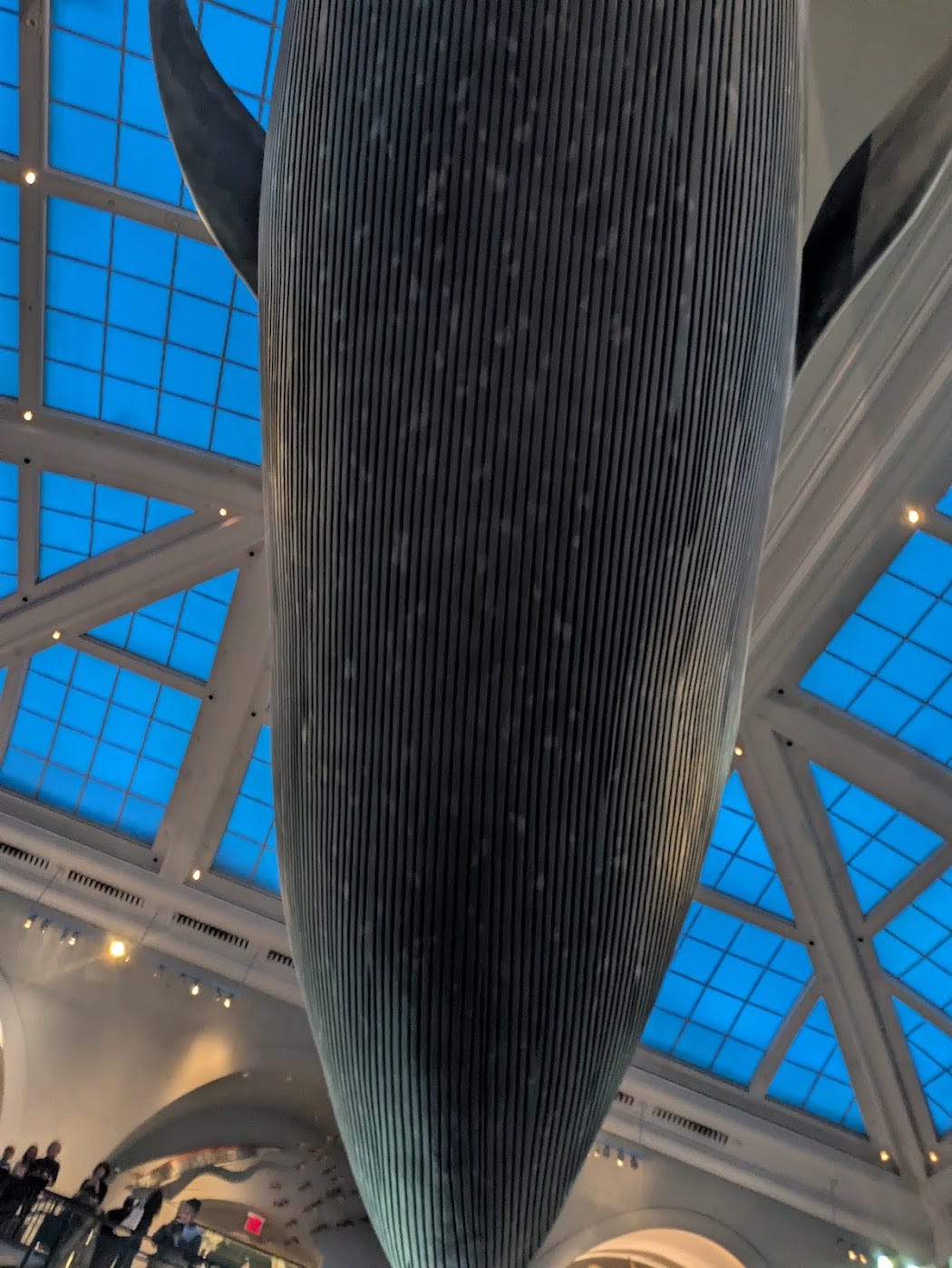
When a nine year old asks to visit the American Museum of Natural History, you go. So there we were, on Sunday afternoon, lying on our backs, gazing up through the perpetual twilight at the great blue whale.
I almost dozed off at the bottom of that dim bowl-shaped chamber. Soothing waves of hubbub formed and crashed into the walls of glass encasing the elephant seals and the polar bears. Stroller-bound children screeched like the little primates they are.
The 94-foot whale, a model of one of the largest creatures to ever live, graces our city like a holy relic. We roam, all of us, under its little rhinoceros eye.
E. and I started musing what archaeologists of the future might conclude about the museum—when the fossils, and the plastic fossils from the gift shop, are all re-fossilized together. An image swims into my mind’s eye: this room a roofless ruin, like the Colosseum. The whale floating in the open air.
“Will there still be scientists?” She wanted to know.
Great question. It gave me a hot pulse of shame. Because lately, I seem to have mislaid my capacity to care about the ongoing destruction of the planet.
Outwardly, it’s looked the same. I’ve been showing up to marches and making phone calls and giving money and doing my work for various orgs. People tend to bring me their climate feelings and questions, because I’m known for caring about this. So I’ve been shaking my head or nodding at parties, depending. But inside, my heart is an elevator button that won’t light up. I haven’t been able to access anything but an exhausted shrug.
In fairness, there have been so many terrible things happening every day out there in this world. I’m often at my psychophysical ceiling, grief- and distress-wise.
And then again, the fall has been so gentle, prismatic leaves, nostalgically cool and wet. We even had a light dust of snow two weeks ago.
While I was preoccupied, people in power took another year we don’t have to tell us that they won’t fix this. The 30th Council of the Parties, the annual international climate meeting, concluded just now in Belém, Brazil, without the official participation of the United States and many American CEOs.
Per my friend Genevieve Guenther, who focuses on ending climate silence:
The conference was a failure. Its outcome, the decision text known as the Global Mutirão or Global Collective Effort, is, in essence, a form of climate denial...it never even mentions fossil fuels.
Ecofascism says shut up. Avert your eyes from the guy holding the knife at your throat, so you can’t identify the perp. Climate concern has dropped significantly in rich countries in the past few years; it seems the combination of silence and loud distractions are working.
Plenty of smart people have been saying for a long time that the idea of a global elite-led, orderly, just transition to a bright-green future is nothing more than a pipe(line) dream.
The Epstein emails, as Anand Giridharadas pointed out recently in the New York Times, underline the corrosive, collusive, corruption of what he calls the “carbon-offset-private-jet set.”
In the emails, Epstein traffics in climate denial. “Maybe climate change is a good way of dealing with overpopulation,” replies a genocidal shithead who’s held MIT and Harvard appointments.
Those people won’t save us. They won’t even save themselves. In the era of Trump 2.0, they’ve stopped pretending to care. The NYT:
This year, several big technology companies acknowledged that they would not meet their climate targets because of their investments in power-hungry data centers needed for artificial intelligence. Even before Mr. Trump’s second term began, many of the country’s biggest financial firms had quit their industry climate alliances.
Thanks to their “predatory delay,” as Alex Steffen puts it, we have now muddled our way close to what is called overshoot. That means life outside livable limits.
Earlier this month a group of researchers published a paper titled “Living beyond limits: Consequences of missing the decisive decade for preserving our planet’s life-supporting systems.”
Two authors expanded in The Conversation:
Not only do extreme climate events, like droughts, floods, fires and heatwaves grow in number and severity, impacting billions of people, we also approach tipping points for large Earth regulating systems like the Amazon rainforest and the Greenland and West Antarctic ice sheets.
Tipping points are changes that only go one way. If the rainforest, the lungs of the earth, burns, really burns, it turns into grassland. It’s not a rainforest ever again. If the ice sheets melt the oceans rise, engulfing cities housing millions of people. The Atlantic Meridional Overturning Circulation might falter and plunge us into instability, the likes of which we can only dimly extrapolate from the fossil record. This can all happen within my nine year old’s lifetime.
I say it, but I don’t believe it. I tell you, but you don’t believe it. Sound waves form, break, and scatter harmlessly around the perimeter of a vast space where I float in a bubble with my loved one. None of the fellow creatures here can have expected their own extinction, let alone this eerie afterlife, backlit in an artificial habitat. Maybe, unsuspectingly, we are already installed somewhere—Early 21st Century North American Mother and Child. It’s surprisingly realistic.
We venture upstairs, to a special temporary exhibition called Life at the Limits. Here the curators have assembled displays of the extremes that our fellow creatures manage to exploit and endure.
Coral reefs release their spawn once a year, at moonrise after a full moon. It’s not known exactly how they manage to coordinate this, but a role is played by light-sensitive proteins, called, delightfully, cryptochromes.
Arctic terns migrate 25,000 miles round trip between the planet’s two poles each year.
Certain kind of moths in Africa can jam the supersonic signals of bats that are trying to echolocate and eat them.
And the coral reefs are bleaching in the sweltering oceans, and the poles are fracturing and melting, and the insects are all dying off. But tardigrades, AKA water bears, AKA moss piglets, will surely survive us. They are microscopic eight-legged creatures with round snouts that managed to live two weeks in outer space without spacesuits. They might have accidentally colonized the moon.
The single global consensus of dominant powers might fail, but smaller, more diverse efforts toward a livable future are going forward. At COP 30, 24 nations led by Colombia and the Netherlands announced they are going it alone to create a roadmap to fossil fuel phaseout, beginning with a conference in April 2026. As Guenther writes, citizen effort is crucial to hold these countries to it and help them build momentum. That means you and me.
What I’m trying to say is there was no sadness for us on the third floor, even as I imagined what natural and unnatural history might engulf us. Only love. Only amazement to share this earth with these creatures at this time. Amazement that careened, in the darkness, perilously close to the mouth of hope, a word too tender right now to touch.
Because the world is not only wilder than we imagine; it’s wilder than we can imagine, and survival is its sole unifying principle, our true global collective effort.
A Gratitude Meditation
My friend Mor Keshet published this beautiful reflection on nature and gratitude in Psychology Today.
In its deepest expression, gratitude is not something we think – it’s something we embody: relational, intentional, alive. And when we extend our gratitude to the more-than-human world – the cycles, textures, and wild creativity of nature – something palpable shifts. We begin to experience a sense of interbeing, a term coined by the Buddhist monk Thich Nhat Hanh, that describes the felt understanding that we are part of a living, interconnected system.
Come study and practice with me!
I’m offering a 5-week online program, February 26 – March 26, 2026, in line with my forthcoming book, to examine our collective emotional responses to the crises of our time and learn to find inspiration even in the depths of despair.
Explore your emotions with curiosity – building resilience and working with the energy within our bodies. Together, we will:
Map our collective pain for the world: identifying the spiral and the wheel
Discover the healing alchemy: transforming your grief, rage, apathy, fear and despair
Call In your resources and refuges: exploring body and breath, relationship and community, nature and the sacred, ancestral mentors and deep time
Practice each week: grounding ourselves in guided meditation, creative exercises in movement, art and writing, and group work
Study the wisdom: tuning into prophets, rabbis, lamas, mystics, Indigenous sages, neuroscientists, ecologists, and activists.
The Institute for Jewish Spirituality has a number of wonderful offerings you can check out here; but you don’t need to be Jewish to sign up!
See me in Brooklyn Dec 19!
I’ll be collaborating with eco-therapists Maia Kiley and Thomas Doherty , author of Surviving Climate Anxiety, on an intimate solstice gathering on December 19, to celebrate our diverse ecological identities, lived experience in connection with Nature, and personal empowerment in an era of polarization and climate change. It will be juicy! With community building, embodied exercises, music, and collective visioning.
SIgn up now as space is limited! https://www.maiakiley.com/ecohealth
This line is really something: "But inside, my heart is an elevator button that won’t light up." It helps to know someone as engaged and ethical as you also sometimes has trouble getting the button to light up!
This article comes at the perfect time. With such insightfull reflections on that 'hot pulse of shame', how do you manage to keep up the fight?